As global energy markets face increasing uncertainty, many users are asking:
With rising oil prices and geopolitical tensions, is it time to replace diesel generators with solar + battery storage?
Recent tensions between the U.S. and Iran have once again pushed oil prices higher, highlighting a key risk:
Energy systems that rely on fuel are vulnerable.
This is one of the main reasons why solar + storage adoption is accelerating worldwide.
How do rising oil prices affect diesel generators?
Diesel generators depend entirely on fuel. When oil prices increase:
Diesel costs rise immediately
Operating expenses become unpredictable
Long-term energy planning becomes difficult
In contrast:
Solar energy = free
Battery storage = fixed upfront cost
Conclusion:
Solar + storage provides price stability, while diesel brings cost volatility.
Why are geopolitical events accelerating the shift?
Conflicts like the U.S.–Iran situation impact:
Global oil supply/Transportation costs/Local fuel availability
For many regions, especially:
Southeast Asia/Middle East/Africa
This leads to:
Fuel shortages
Higher electricity costs
Increased reliance on backup systems
Businesses and households are now actively looking for fuel-independent energy solutions.
Why is solar + storage a safer long-term choice?
1. No fuel dependency
Solar + storage systems generate and store energy locally.
No reliance on oil supply chains
No exposure to fuel price spikes
2. Predictable long-term cost
Diesel generators:
Ongoing fuel expenses
Maintenance costs
Price fluctuations
Solar + storage:
One-time investment
Stable long-term savings
3. Better reliability during crises
During geopolitical instability:
Fuel logistics may be disrupted
Diesel availability may be limited
Solar + storage systems continue to operate as long as:
Sunlight is available
Battery capacity is sufficient
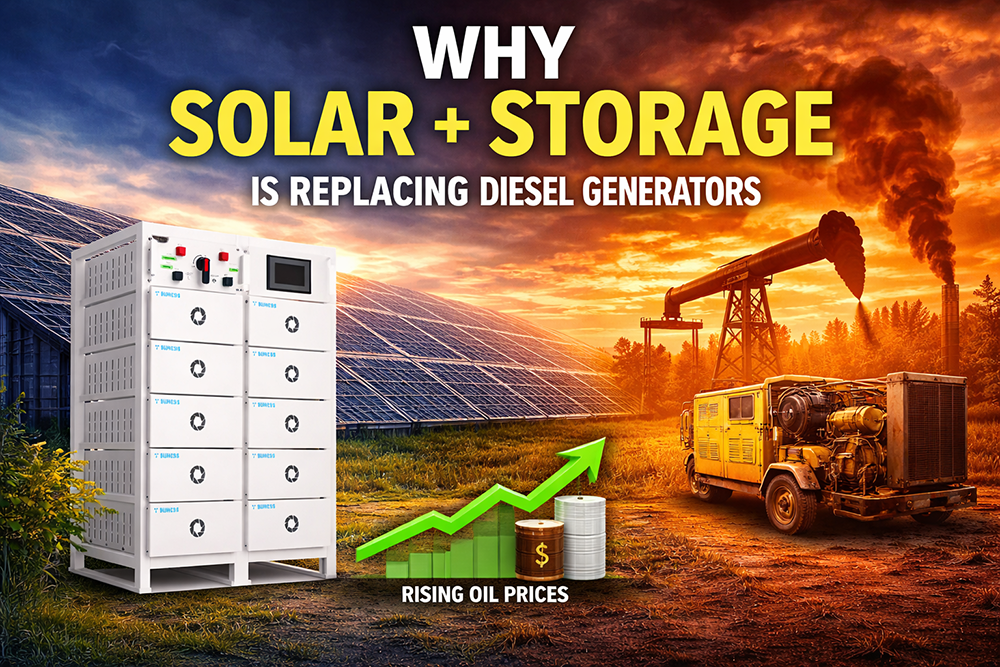
Is solar + storage now more economical than diesel?
In many markets, the answer is:
Yes — especially over the long term
Cost comparison:
| Factor |
Solar + Storage |
Diesel Generator |
| Fuel Cost |
None |
High & variable |
| Maintenance |
Low |
High |
| Lifetime Cost |
Lower |
Higher |
| ROI |
Improving |
Declining |
Rising oil prices are shortening the payback period of battery storage systems.
Who benefits the most from this shift?
Residential users
Reduce electricity bills
Avoid outages
Gain energy independence
Commercial & industrial users
Lower operating costs
Avoid peak electricity pricing
Improve business continuity
Installers & distributors
Higher demand for solar + storage systems
Opportunity to replace generator-based solutions
Recurring revenue from energy systems
What should energy businesses do now?
This trend creates a clear strategic direction:
1. Replace “generator sales” with “energy solutions”
Instead of selling:
Diesel generators
Focus on:
Solar + battery systems
Hybrid energy solutions
2. Educate customers on fuel risk
Customers often underestimate:
Fuel price volatility
Long-term generator cost
Content marketing should focus on:
“Cost of diesel vs cost of solar + storage”
3. Offer scalable battery solutions
Start small, expand later:
Residential → 5–15kWh
Commercial → 30–200kWh+
Final Insight
Rising oil prices and geopolitical tensions are accelerating a global shift away from diesel generators.
Solar + storage is no longer just a green option

 EN
EN
 ES
ES
 AR
AR
 PT
PT
 TL
TL
 MY
MY